

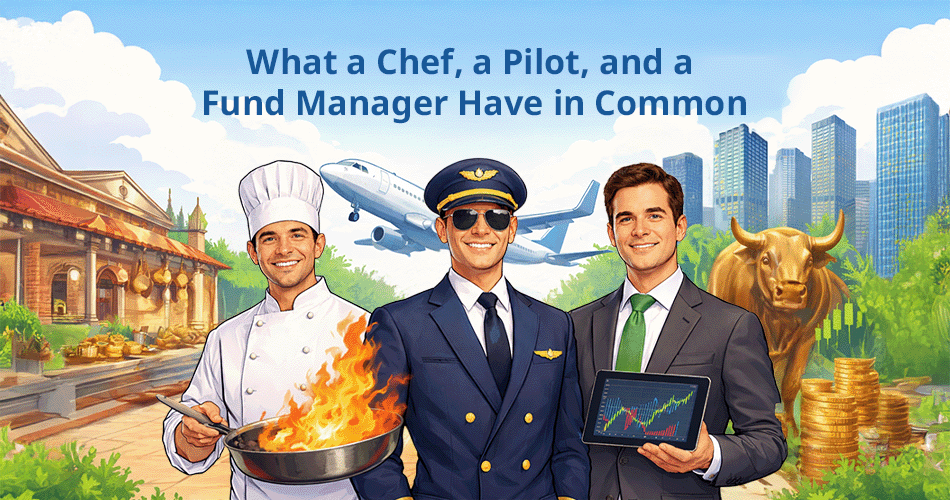
What a Chef, a Pilot, and a Fund Manager Have in Common
At first glance, a chef, a pilot, and a fund manager seem to live in completely different worlds. One works in a kitchen, one in a cockpit, and one behind screens filled with numbers and charts. Their tools, environments, and daily pressures are entirely different.
Yet, at the core of what they do, there are striking similarities. All three operate in high-stakes environments where decisions can affect others, not just themselves. A single choice, made without care or preparation, can have lasting consequences.
That is why all three rely on structure, discipline, and trained expertise far more than instinct or luck. Recognising this common thread helps explain why informed, process-driven decision-making matters—not only in flying planes or preparing meals, but also in managing investments steadily over time.
The Chef: Mastery Through Preparation, Not Guesswork
A good chef doesn’t walk into the kitchen and start cooking randomly. There is long planning before the dish reaches the plate. Ingredients are selected carefully. Recipes are tested. Techniques are refined over years of experience. Even creativity in cooking follows structure. A chef understands why ingredients are combined, when heat should be adjusted, and how timing influences taste. Improvisation, when it happens, is built on deep understanding — not impulse.
Perhaps the most important element is consistency. When people visit a restaurant, they expect the same dish to taste familiar each time. That consistency comes from discipline, not chance. A chef follows processes even on busy days, even under pressure.
This highlights the first common trait: results are rarely the outcome of guessing — they tend to come from preparation and repeatable systems.
The Pilot: Calm Decisions in Uncertain Conditions
A pilot flies thousands of people safely every day — not because the skies are always calm, but because they are trained to handle uncertainty. Pilots don’t rely on instinct alone. They follow checklists. They trust instruments. They stick to protocols even when emotions might suggest panic. When turbulence hits, the pilot doesn’t abandon the route. They adjust carefully, staying focused on the destination.
Most importantly, pilots are trained not to overreact. Sudden movements, unnecessary actions, or emotionally driven decisions can create more risk than the situation itself. So they remain composed, follow procedures, and let training guide their response. This discipline matters because not every situation can be predicted. Weather changes. Air traffic shifts. Conditions evolve. Structure allows pilots to manage the unexpected without chaos.
This is the second common trait: expertise lies in staying calm and structured when conditions are unpredictable.
The Fund Manager: Discipline in a World of Noise
Like chefs and pilots, fund managers operate in environments filled with pressure and uncertainty. Markets rise, fall, and move sideways. News changes daily. Opinions are loud. Emotions run high. Yet a professional fund manager cannot rely on emotion. Decisions are informed by research, valuation frameworks, risk considerations, and the fund’s long-term strategy. Every move is guided by a defined process.
Just as a chef doesn’t change a recipe because one customer complained, and a pilot doesn’t abandon a route due to mild turbulence, a fund manager doesn’t alter strategy solely because of short-term market volatility. Their role is not to predict every market movement — but to navigate through cycles with discipline and consistency. They recognise that reacting to every fluctuation can introduce instability rather than clarity.
This is the third common trait: long-term outcomes are shaped more by process than by momentary emotion.
Why Structure Matters More Than Brilliance
Many people believe success comes from brilliance — a great recipe, a heroic pilot move, or a perfectly timed investment call. In reality, success more often comes from structure.
A chef succeeds because they follow systems consistently.
A pilot succeeds because they trust protocols under pressure.
A fund manager succeeds because they adhere to strategy through different market cycles.
Structure helps reduce mistakes. Structure limits emotionally driven decision. Structure allows outcomes to be more repeatable over time. This is why expert-led systems tend to be more reliable than individual instincts across longer periods. Talent may create moments of success - but discipline is what helps sustain it.
The Role of Discipline When Things Go Wrong
No kitchen runs perfectly every day.
No flight is free from turbulence.
No market moves in a straight line.
The true test of expertise emerges during difficulty. When a dish doesn’t turn out as expected, a chef doesn’t panic - they adjust methodically. When turbulence increases, a pilot doesn’t rush - they focus on stabilising first. When markets fall, a fund manager doesn’t react blindly - they reassess carefully.
Discipline creates space between emotion and action. That space is where considered decisions are made. For investors, this distinction is important. Many mistakes don’t happen simply because markets are volatile — they tend to occur when emotions override discipline.
Why Individuals Struggle Where Experts Succeed
Most individuals struggle with investing not because they lack intelligence, but because they lack systems.
A home cook may be talented, but without structure, consistency becomes difficult. A passenger may panic during turbulence, but the pilot remains calm because of training and protocols. An individual investor may react emotionally, but a fund manager operates within a defined process.
Professionals tend to perform with greater consistency because they work within systems that help limit emotional interference. This is why structured investing tools can play such an important role — they introduce discipline where emotion would otherwise dominate.
Mutual Funds: Designed Like a Professional System
Mutual Funds are built on principles similar to those that guide chefs, pilots, and professional fund managers. They rely on research rather than guesswork. They follow asset allocation rather than emotion. They apply risk management rather than panic.
For investors, this means you don’t need to make decisions every day. The structure is designed to handle routine discipline. SIPs help automate consistency. Diversification helps manage risk. Professional oversight supports continuity through different market phases.
Just as passengers don’t fly the plane themselves, investors don’t need to manage every market movement on their own.
Why Doing Less Often Leads to Better Outcomes
In all three professions, unnecessary action tends to create problems. A chef who keeps changing ingredients disrupts consistency. A pilot who reacts aggressively can worsen turbulence. An investor who frequently changes strategy can interrupt the compounding process.
Expertise is often about knowing when not to act. This is one of the harder lessons for investors to learn. Activity feels productive, but restraint is often more valuable. Over time, sustainable progress is more closely linked to staying committed to a process than to constantly interfering with it.
A Simple Story: Three Roles, One Lesson
Imagine a dinner served on a flight.
The chef planned the recipe days in advance.
The pilot navigated the changing weather calmly.
A fund manager, somewhere on the ground, managed a portfolio through a volatile market day.
Each faced uncertainty. Each relied on systems. Each avoided emotionally driven decisions.
And the outcome? A safe flight. A familiar, consistent meal. And a portfolio that remained aligned with long-term objectives. Different professions. Same mindset.
The Shared Lesson for Investors
You don’t need to be a chef, a pilot, or a fund manager to benefit from their approach. You only need to borrow their principles.
Follow structure instead of instinct.
Trust process instead of noise.
Value discipline over excitement.
Investing doesn’t reward those who react the fastest. It tends to favour those who remain consistent over time.
Conclusion: Expertise Is Quiet, Not Dramatic
A chef doesn’t announce every dish.
A pilot doesn’t call out every correction.
A fund manager doesn’t highlight every market move.
Expertise is often quiet. It works in the background. It shows up over time — not instantly.
The common thread between a chef, a pilot, and a fund manager is not talent alone. It is discipline under pressure, respect for process, and calm decision-making. And these same qualities play a crucial role in successful investing.
This content is for investor education only. I/we act as an AMFI‑registered Mutual Fund Distributor and do not provide investment advice. This blog should not be treated as investment advice or a recommendation. Mutual Fund investments are subject to market risks. Read all scheme-related documents carefully.
14, Bentinck Street, 3rd Floor
Gujarat Mansion Kolkata-700001
Branch Office
Shop No. 69, Ground Floor, Millennium
Textile Market-4, Near Sidhhi Vinayak Mandir,
Bhatena, Surat-395002
+91 9830177150
+91 7044341207
Smk Finserv © 2023


.png)
.png)